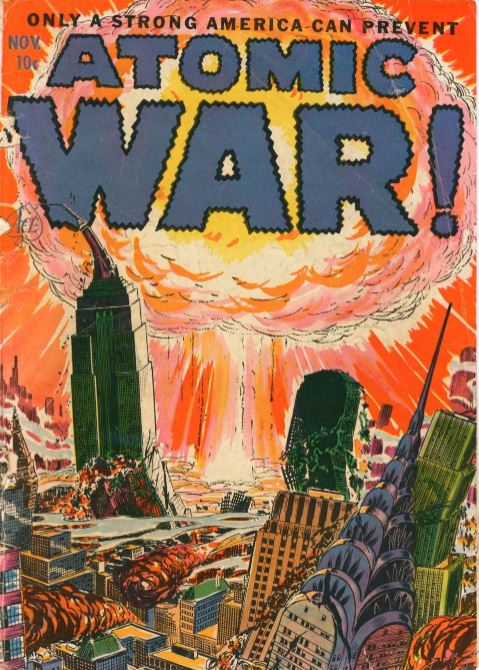
Comic Book Plus has a collection of “Atomic Comics” from the late 1940s through the 1950s that attempted to capitalize on the public’s fascination with atomic energy.


Comic Book Plus has a collection of “Atomic Comics” from the late 1940s through the 1950s that attempted to capitalize on the public’s fascination with atomic energy.
Feather River College offers a free online version of the classic solo board game Israeli Independence: The First Arab-Israeli War 1948 – 1949. The original printed game was published by Victory Point and now is many years out of date and hard to find.
It’s fun (and educational).
My friend Jim loves to run dreadnaught era naval miniature wargames. Here’s a good scenario for the Battle of the Yellow Sea from Bill Madison of the Naval Wargames Society.
Admiral is the story of Admiral Aleksandr Kolchak, and his fight against the Bolsheviks during the Russian Revolution.
From Wikipedia:
Alexander Vasilyevich Kolchak CB (Russian: Алекса́ндр Васи́льевич Колча́к, 16 November [O.S. 4 November] 1874 – 7 February 1920) was a polar explorer and commander in the Imperial Russian Navy, who fought in the Russo-Japanese War and the First World War. During the Russian Civil War, he established an anti-communist government in Siberia—later the Provisional All-Russian Government—and was recognised as the “Supreme Ruler and Commander-in-Chief of All Russian Land and Sea Forces” by the other leaders of the White movement from 1918 to 1920.[1] His government was based in Omsk, in southwestern Siberia.
For a year and a half, Kolchak was the internationally recognised leader of Russia. However, his effort to unite the anti-Bolshevik elements mostly failed; Kolchak refused to consider autonomy for ethnic minorities and refused to cooperate with non-Bolshevik leftists, and also heavily relied on outside aid. As his White forces fell apart, he was betrayed and captured by independent units who handed him over to local Bolsheviks, who executed him
Here’s a collection of color photos from around the world taken by French banker Albert Khan as he toured the world — in 1909!