

Here’s a tutorial on scratch build a void shield generator. While intended for Warhammer 40K, a model like this could be used in a lot of science fiction games.
Month: November 2017
Offa And The Mercian Wars – Book Review
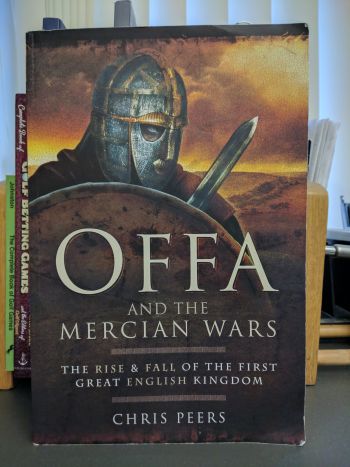 Offa and The Mercian Wars Book Review
Offa and the Mercian Wars:The Rise and Fall of the First Great English Kingdom
by Chris Peers
In Offa and The Mercian Wars, Chris Peers offers an intriguing look at the powerful Dark Ages Kingdom of Mercia. Beginning around 600 AD in the central part of the island and continuing for nearly three hundred years, Mercia grew to be the region’s superpower. At its peak, Offa’s Mercian Kingdom encompassed most of southern England, including East Anglia, Essex, Kent, Sussex and Wessex.
Author Chris Peers is well known in miniature wargaming circles, both for his historical writing, and for his gaming rules sets and sourcebooks. Peers’ work in Offa is largely drawn from primary sources such as the Anglo Saxon Chronicles, Bede’s History of the English Church, Malmesbury’s Chronicles of the Kings of England; and from archaeological evidence.
I was surprised and pleased at how much Peers was able to reconstruct of this Dark Ages kingdom and of its greatest ruler, Offa. Fragmentary and sometimes contradictory or biased accounts are supplemented with archaeology and a good dose of common sense.
For example, Peers offers the story of Aethelberht the Martyr, as recounted by one Osbert of Clare. Aethelberht, it seems, was the religious young King of East Anglia, who went on a mission to ask for the hand of Offa’s daughter. While in Merica, he is seized, and beheaded ostensibly at Offa’s order under the urging of Queen Cynefrith. Aethelberht was supposed to have been plotting an invasion, not a wooing. The young pious King’s body, thrown into the River Lugg, is naturally later associated with various miracles.
Of this account, Peers writes:
The story has become well known, but can hardly be accepted at face value. Even if we concede that Osbert or the source upon which he drew preserved a genuine memory of events, their obvious East Anglian bias must be taken into account. The role of Cynefrith cannot be confirmed, and may be a device to avoid putting the blame for the crime onto a respected monarch such as Offa … Osbert remarks in passing that an earthquake as the young king set out terrified ‘the whole war band’, which reminds us that no Anglo-Saxon king would have travelled without a bodyguard. Perhaps his following was large and well equipped enough to me mistaken for an invading army.”
The excerpt above also illustrates, I think, the difficulty of obtaining large amounts of irrefutable evidence from the “Dark Ages.” They’re called that for a reason.
To his reconstruction of the history of the Kingdom of Mercia, Peers adds information on geography; military strategy, tactics and equipment; religion and other background. All of this helped to put the story of Mercia into context.
Offa and the Mercian Wars:The Rise and Fall of the First Great English Kingdom is worthy of a read by folk interested in the Dark Ages period. I enjoyed it a lot, and as usual, after reading such a book, I’m ready to go out and buy some Mercian miniatures.
WRG Infantry Action 1925 – 1975 Rules
The classic WRG Infantry Action 1925 – 1975 rules are available free for the downloading. These are the June, 1972 edition of the rules. The link opens a pdf.
Spaceship Miniatures and Games List
Tom’s Spaceship Miniatures / Games List offers a nice resource for people getting into this type of gaming. FWIW, Silent Death is one of my all time favorite games.
Imperium: From Republic To Empire Print-And-Play
Imperium: From Republic to Emprie is a free print-and-play game of political intrigue in the Roman Empire. It’s billed as an alternative to the classic, much-sought-after Republic of Rome.
Imperium: From Republic to Empire
Imperium: From Republic to Empire

In Imperium: From Republic to Empire, players control factions of influential Roman Senators, each with a unique combination of military skill, political skill, and ideology. Factions gain prestige points by successfully leveraging the strengths of their senators, political opportunities, senatorial influence, and treasuries as they engage in various aspects of Roman politics. Prestige is earned by being elected to high office, success in war, sponsoring public games, earning nobility, enacting justice, and persuading other senators to join their faction. Prestige can also be lost through military failures and by being convicted of corruption. Victory is declared when one senator or faction has gained sufficient prestige as to be crowned the First Emperor of Rome. However, success will require both competition and cooperation as all factions must work together to ensure the stability of Rome. Failures of the Senate and unmet public demand will increase civil unrest, leading to revolt. Excessive war involvement will overextend Rome’s military resources. Spending more funds than what is available will bankrupt the State Treasury. Any of these situations will ensure the fall of Rome causing all players to lose the game. Throughout the game, actions are numerically resolved using senators’ individual attributes, shared State resources, faction resources, and dice. Primary mechanics include probability modification, resource management, and blind bidding. The game is played over a number of rounds until a victory condition is met or until all players are defeated by the game. Each round is made up of six distinct phases, played in the following order: Election Phase: Each player nominates a candidate from their faction to compete for office. The candidates with the most votes (prestige + bribes) are elected to the offices of Consul and Censor. The Consuls will co-lead Rome in political and military affairs while the Censor will be responsible to convict members of the Senate accused of corruption. Minor offices are also assigned to other senators who may also sponsor public games from their faction treasuries to earn prestige and to placate the public. Senate Phase: Senators gather to make decisions related to Rome’s resources. Each resource (gold and legions) is distributed proportionally to all factions based upon the relative number of senators in each faction. Each faction then applies gold to various “proposals” such as the purchase of Public Grain or the raising of additional Legions. Each faction applies available legions to the wars of their choosing. Consuls choose which armies to lead into battle. But beware—an ‘Assassin’ or ‘Mob Incitement’ card in the hands of a jealous senator can severely upset the balance of senatorial power. Republic Phase: Factions take turns making decisions and resolving actions related to their senators working throughout the Republic. Players may choose to have certain senators engage in corruption to gain funds for their faction treasuries. Auxiliary legions may be hired by governors to enhance provincial defenses. Senators in Rome may also attempt to persuade senators to join their faction by the subtle application of personal prestige, ideological attraction, and bribery. Rome must also respond to random events such as public demands, barbarian raids, provincial insurrection, and plagues. War Phase: Wars are now resolved. If victorious, the general returns to Rome with additional prestige and the potential of war spoils. A stalemate will cause the general to return to Rome having lost prestige due to eroding public confidence. A defeat will end in death for the general, an increase in public unrest, and the affected province being overrun. Victorious generals also have the option of “crossing the Rubicon” to engage in civil war with the Roman State in an attempt to secure an early win. Trial Phase: The Censor will prosecute corruption charges of the Senate. For each successful conviction, the Censor gains additional prestige while the accused may either lose prestige or (in the case of murder or treason) be executed. Intersession Phase: Senators may die randomly of natural causes. For those senators who survive the mortality roll, victory conditions are checked. Victory is declared when one faction’s senator has earned 12 prestige points or when a faction has accumulated a total of 30 prestige points. Otherwise, the game is reset for the next round of play. Imperium: From Republic to Empire was designed to be a simplified, less time-consuming alternative to Republic of Rome (Avalon Hill, 1990; Valley Games).
Source: boardgamegeek.com/boardgame/202725/imperium-republic-empire