Carentan details the building of the Second World War French town featured in Band of Brothers for wargaming in 28mm. It contains detailed build notes and many full colour photographs of the process. There is also a section explaining the quest to match the known historical facts with the reality of Carentan today including both period and modern photographs and an analysis of the fighting at the time.
Carentan is a riveting tale of historical research and a valuable modelling resource offered free by Matakishi’s Tea House.
Feather River College offers a free online version of the classic solo board game Israeli Independence: The First Arab-Israeli War 1948 – 1949. The original printed game was published by Victory Point and now is many years out of date and hard to find.
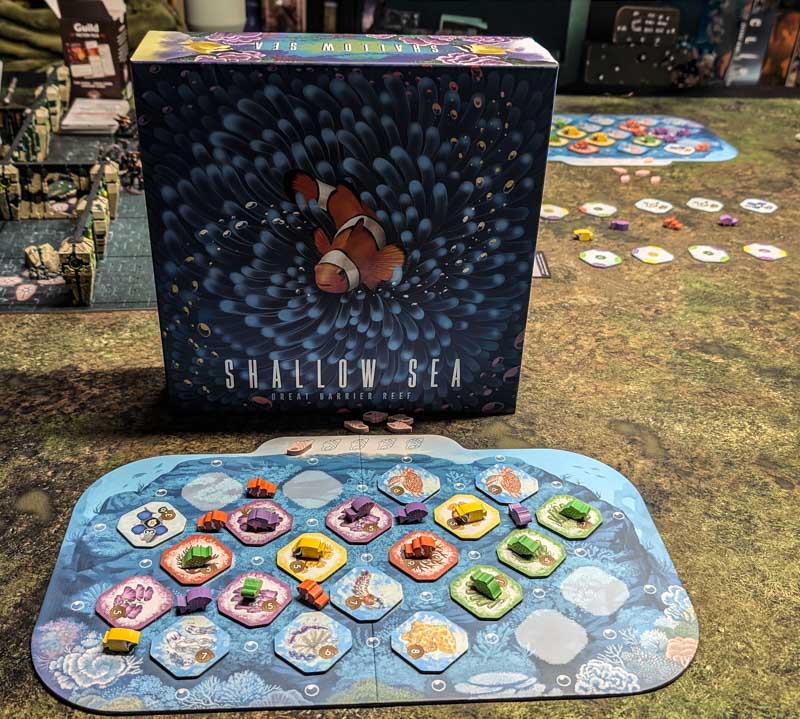
I recently played a game of Shallow Sea at a friend’s house and immediately wanted a copy for myself.
Shallow Sea is a tile laying, open drafting, set collection game. I have a fondness for tile laying games, so was probably predisposed to like it.
In the game, you choose tile and fish pairs from the “market” and place them on your board for scoring. The tiles go on the blank grid spaces. The fish initially go on bubble surrounding the tiles.
There are two types of tiles: coral and sea life.
Coral tiles score when you are able to place the required colored fish around them and flip the tile to its scoring side. For example, a tile might require a green fish on a bubble on one side, and a yellow fish on another. When the tile flips, one of the activating fish is placed on the tile.
Sea life tiles score when certain conditions are met, such as three coral of the same color in a row on one side of the sea life tile.
Completing a tile awards a shell token, which allows players to change the basic rules slightly.
What stood out for me is that the game is very easy to learn, but remarkably thinky in its play. For example, coral score a bonus if a matching colored fish is placed on top when it is flipped. However, if you do, the fish is out of play and can’t be used to fulfill the conditions on another tile. Properly placing tiles with similar requirements adjacent to each other will allow a single fish to work toward the requirements of both. However, that might not be the best move to score the sea life bonuses.
It was one of those games where after the teach, I thought: How hard can this be? A couple of turns in, as I was trying to figure out which pair of fish and tiles to select, I thought: Wow. This can be a brain burner.
The Kickstarter version my friend has featured colorful fish meeples and beautifully illustrated chunky tiles and nice player boards. Hopefully, the retail version is as good.