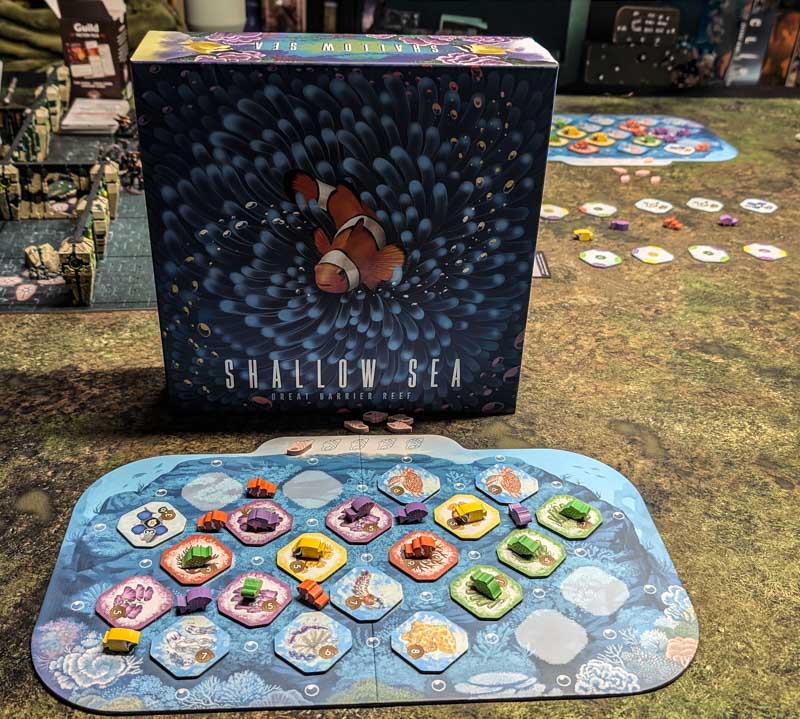
I recently played a game of Shallow Sea at a friend’s house and immediately wanted a copy for myself.
Shallow Sea is a tile laying, open drafting, set collection game. I have a fondness for tile laying games, so was probably predisposed to like it.
In the game, you choose tile and fish pairs from the “market” and place them on your board for scoring. The tiles go on the blank grid spaces. The fish initially go on bubble surrounding the tiles.
There are two types of tiles: coral and sea life.
Coral tiles score when you are able to place the required colored fish around them and flip the tile to its scoring side. For example, a tile might require a green fish on a bubble on one side, and a yellow fish on another. When the tile flips, one of the activating fish is placed on the tile.
Sea life tiles score when certain conditions are met, such as three coral of the same color in a row on one side of the sea life tile.
Completing a tile awards a shell token, which allows players to change the basic rules slightly.
What stood out for me is that the game is very easy to learn, but remarkably thinky in its play. For example, coral score a bonus if a matching colored fish is placed on top when it is flipped. However, if you do, the fish is out of play and can’t be used to fulfill the conditions on another tile. Properly placing tiles with similar requirements adjacent to each other will allow a single fish to work toward the requirements of both. However, that might not be the best move to score the sea life bonuses.
It was one of those games where after the teach, I thought: How hard can this be? A couple of turns in, as I was trying to figure out which pair of fish and tiles to select, I thought: Wow. This can be a brain burner.
The Kickstarter version my friend has featured colorful fish meeples and beautifully illustrated chunky tiles and nice player boards. Hopefully, the retail version is as good.
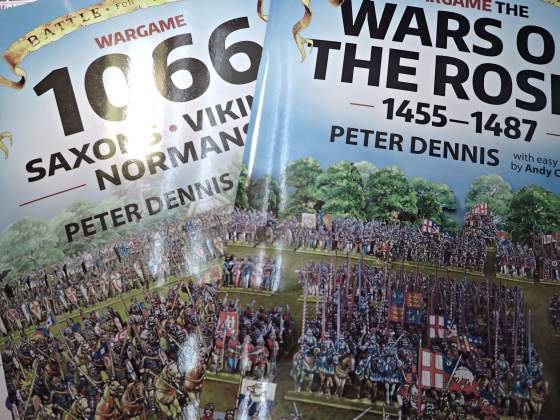
The books each contain around thirty pages of beautifully illustrated, full-color paper models representing all of the troop types necessary to recreate battles of the period on the tabletop. The figures are approximately 30mm from top of helmet to base. Paper models of buildings, trees and other battlefield accessories are included. Finally, the books contain instructions for assembly, as well as simple sets of rules by Andy Callan.
To build your armies, first photocopy the pages with the desired troop types. Then simply cut and paste. In this fashion, you can create as many stands of figures as desired. Don’t need Flemish spearmen? Don’t copy them. Want extra billmen in livery? Copy away.
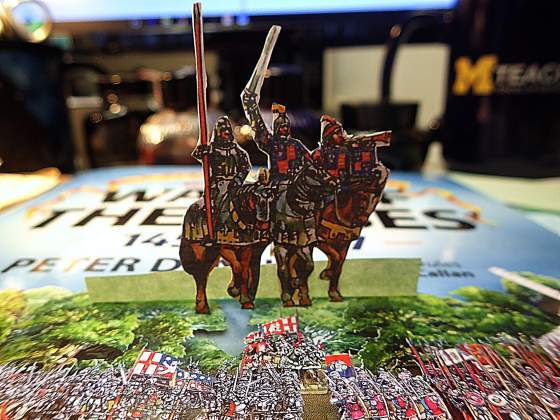
In the example below, I made a copy of a page of cavalry on plain paper with my printer at regular resolution. The copy came out looking pretty good, but if I were doing this to build an army, I’d use heavier inkjet paper and a higher print resolution.
After printing, I followed the instructions in the book: scoring the line, gluing, then cutting. I did a quick job with a lousy pair of school scissors, but I still like the overall effect. With the investment of a little more time and some decent scissors, the paper models would look just first rate — especially in ranks, as designed.
The figures have paper bases for mounting, but I’d suggest gluing those bases to thicker pieces of wood or plastic for easy movement. I also wonder if there isn’t some sort of sealer that would stiffen the figures without making the colors run. Mod Podge, for example, or an artist’s spray sealer.
The Battle For Britain series looks like a great way to quickly build playable, good looking armies for the tabletop. Priced between $20 and $30 on Amazon, they are reasonably affordable, even when taking into account the price of the paper and ink. And based on my experience in quickly cutting out a stand of cavalry, I think you could build an impressive army very quickly.
I am definitely going to build a War of the Roses army. I may even get the English Civil War book. I have long wanted to have armies for both those conflicts.
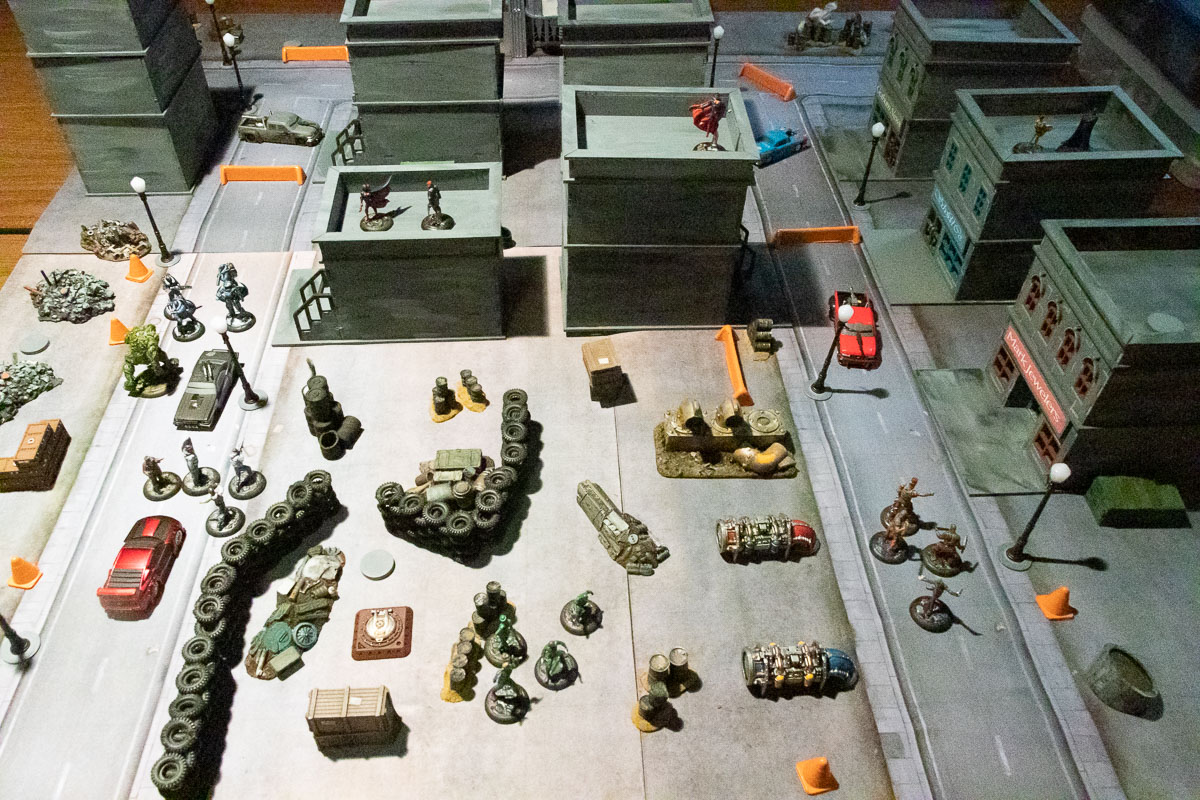
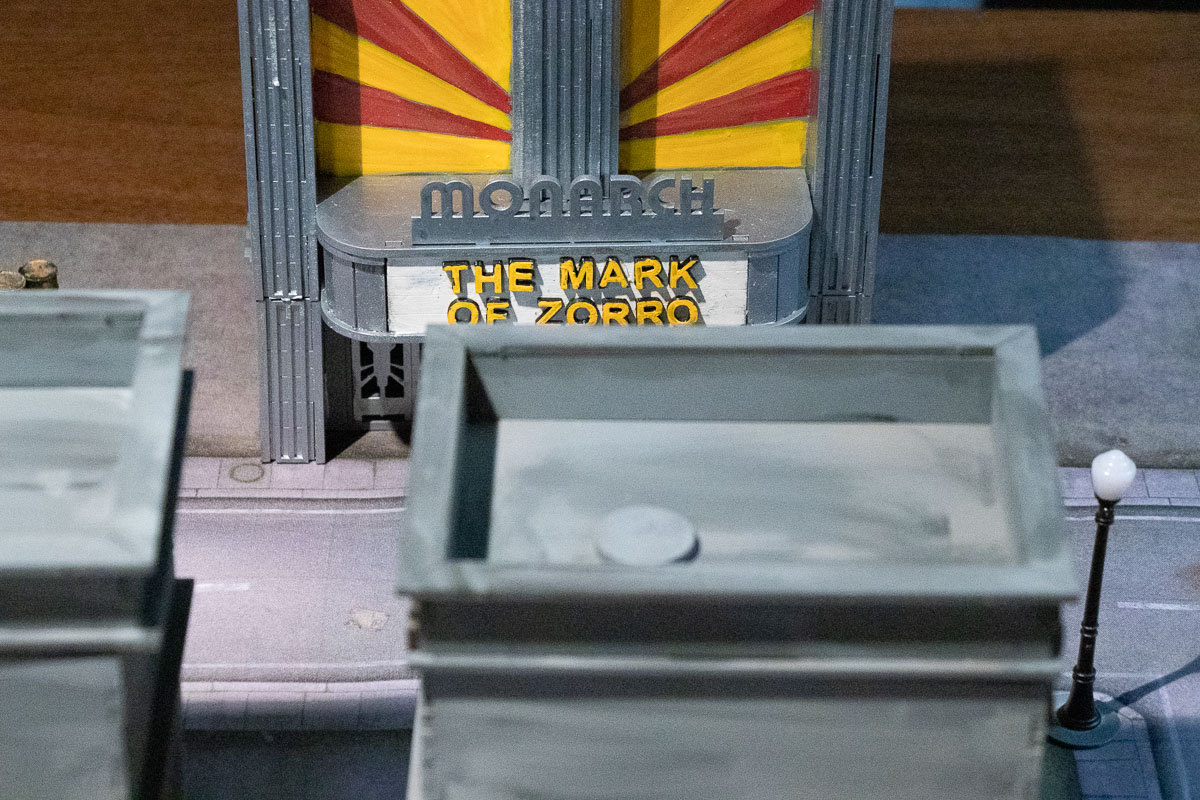
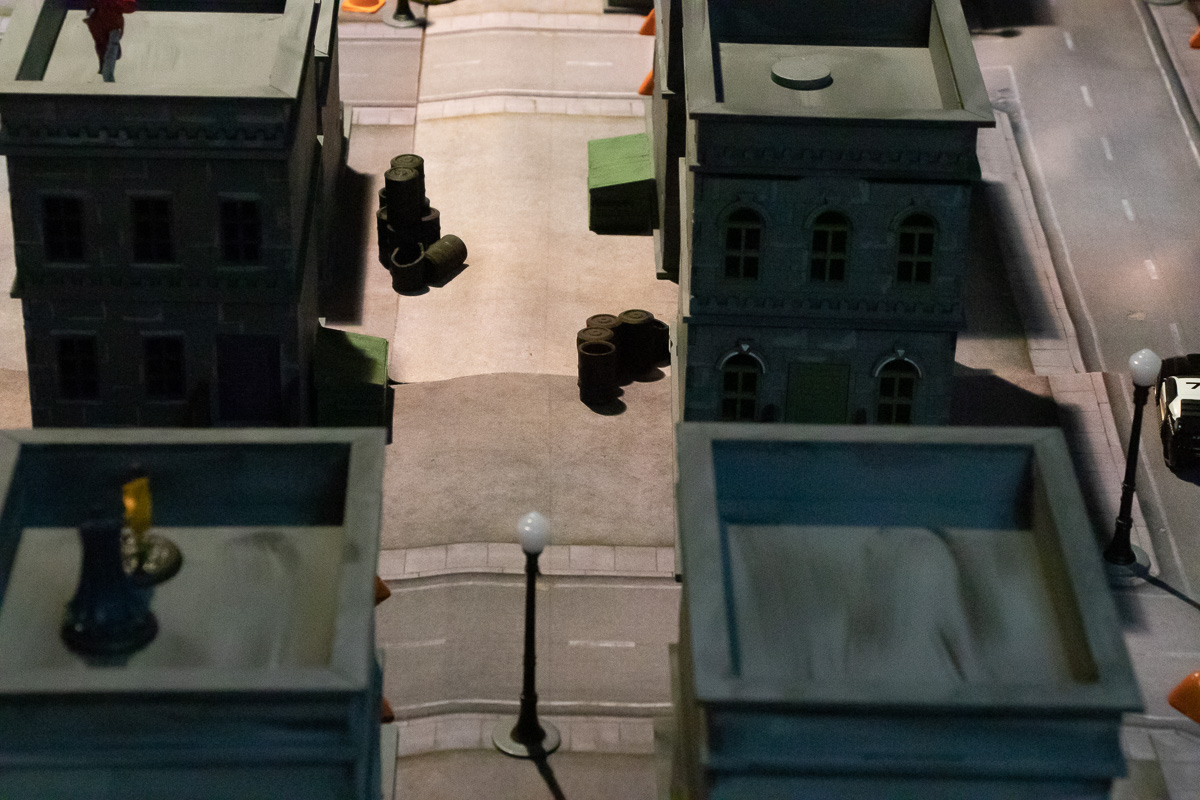
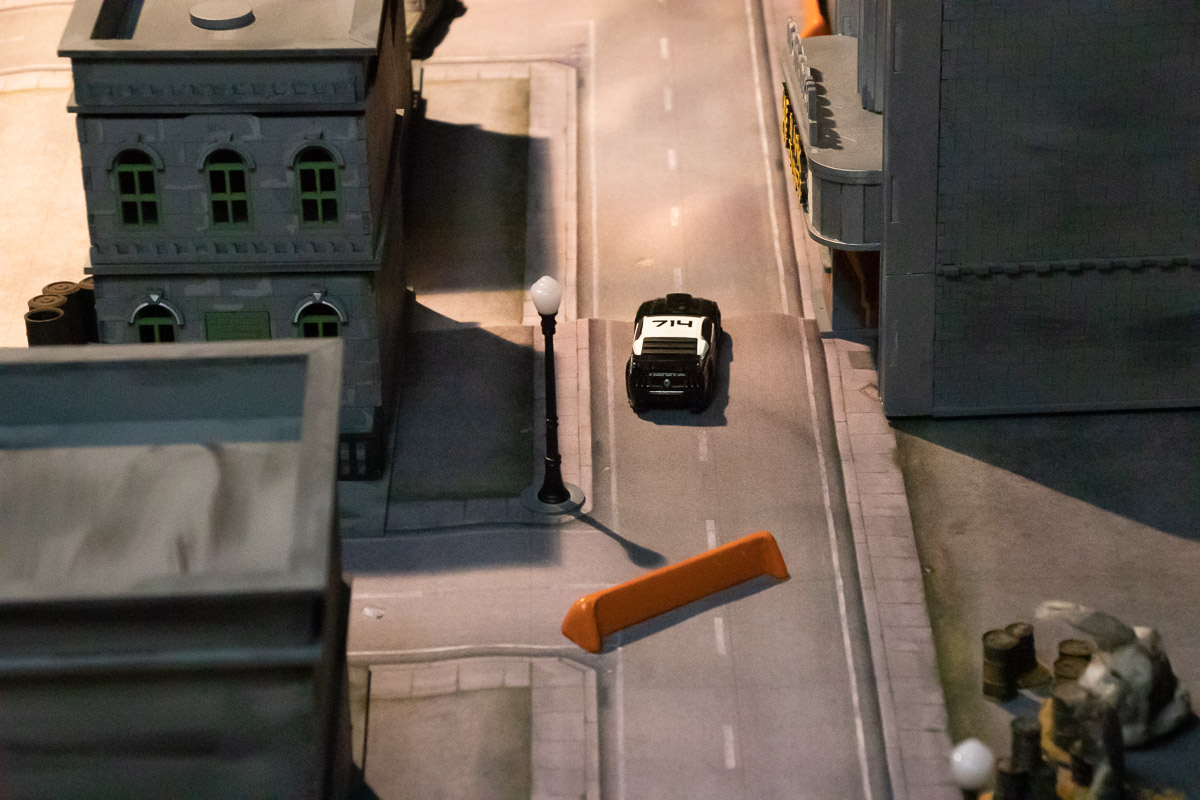
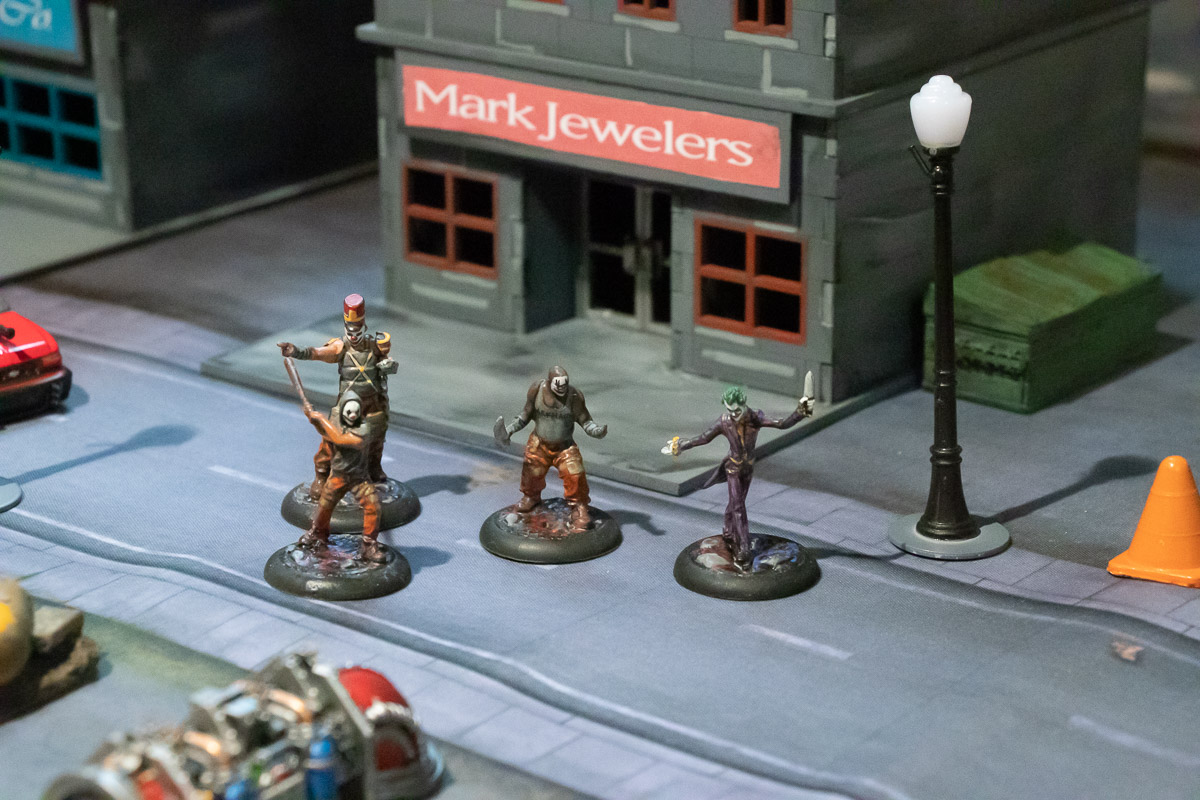
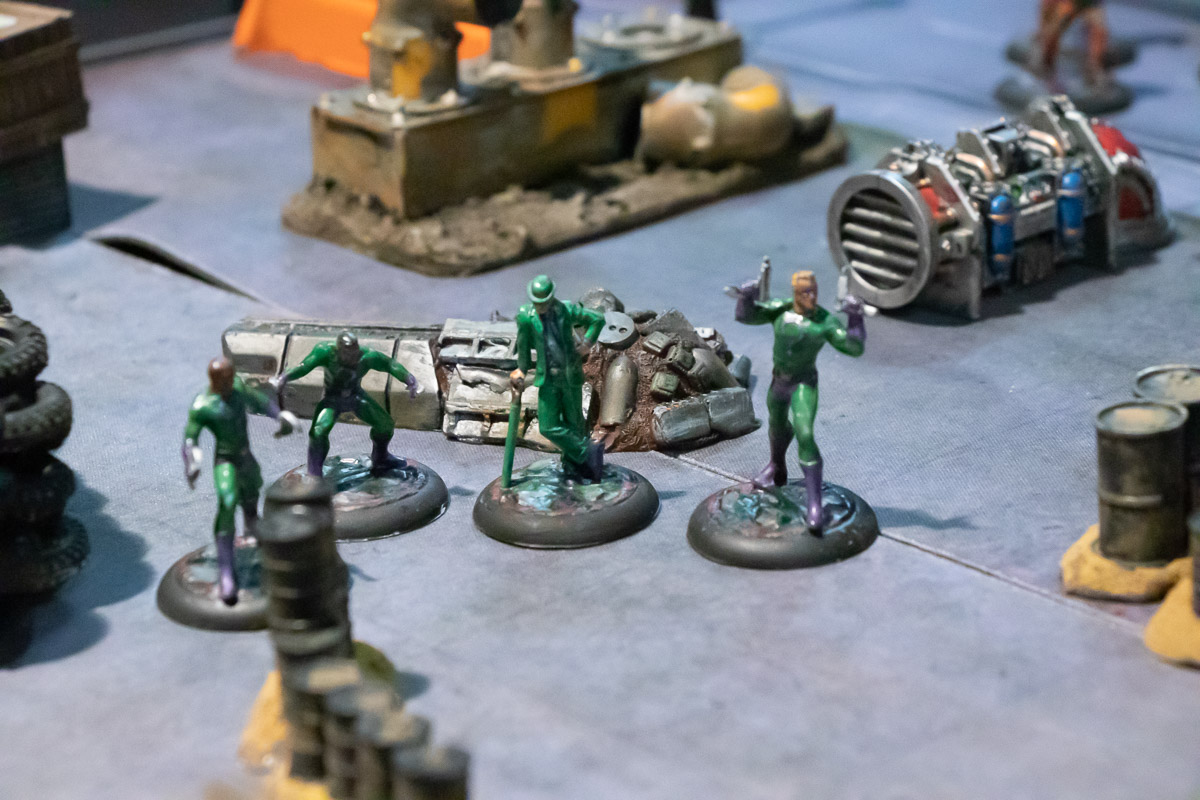
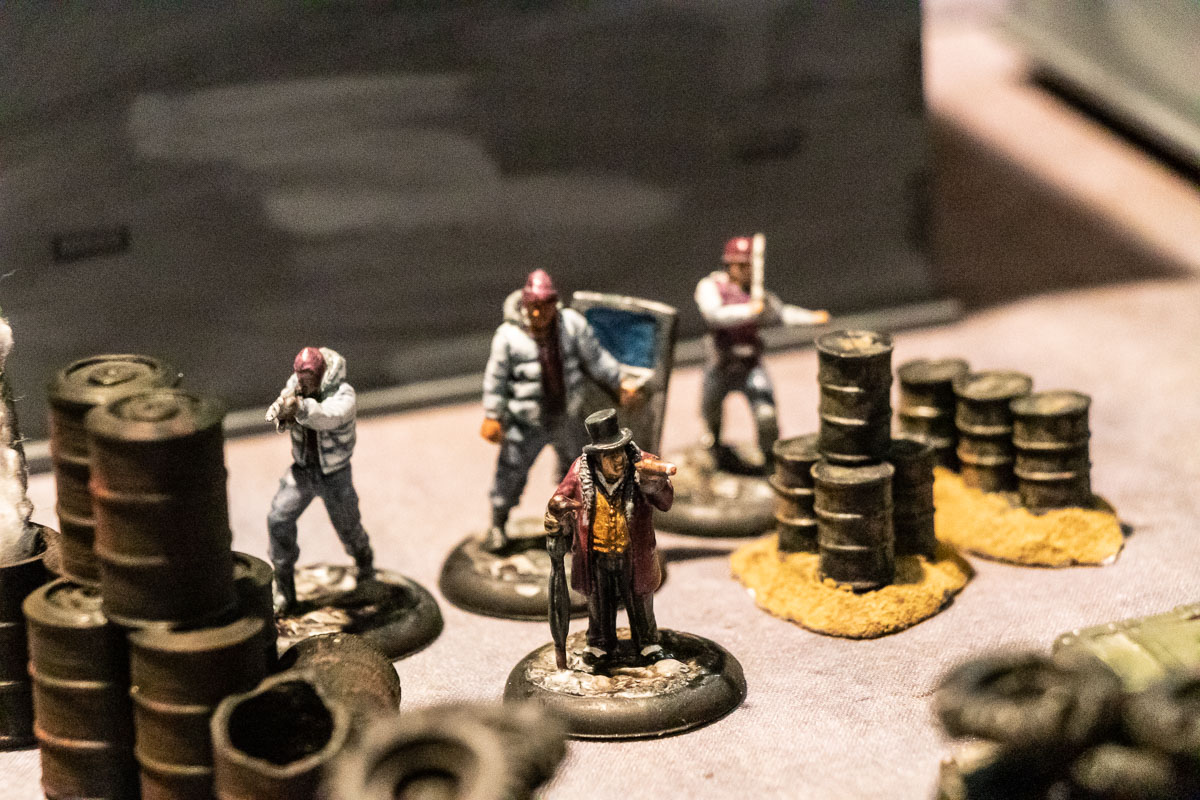
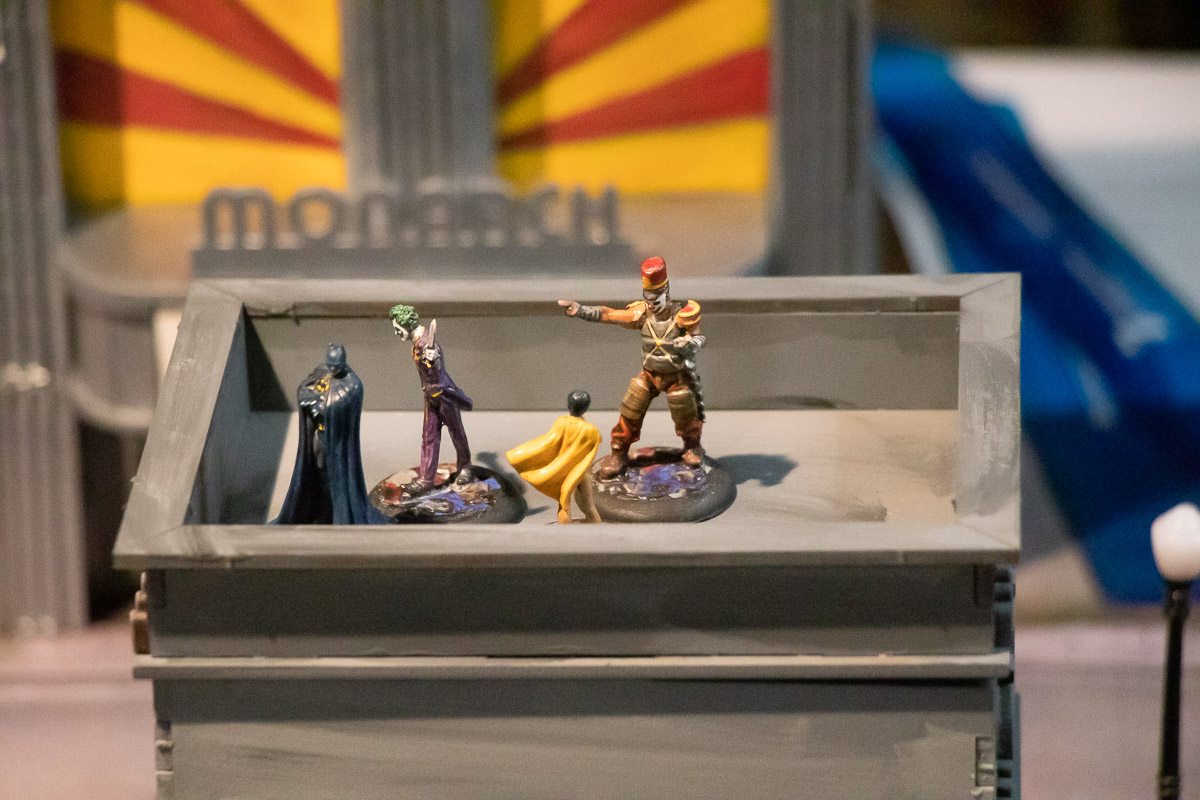
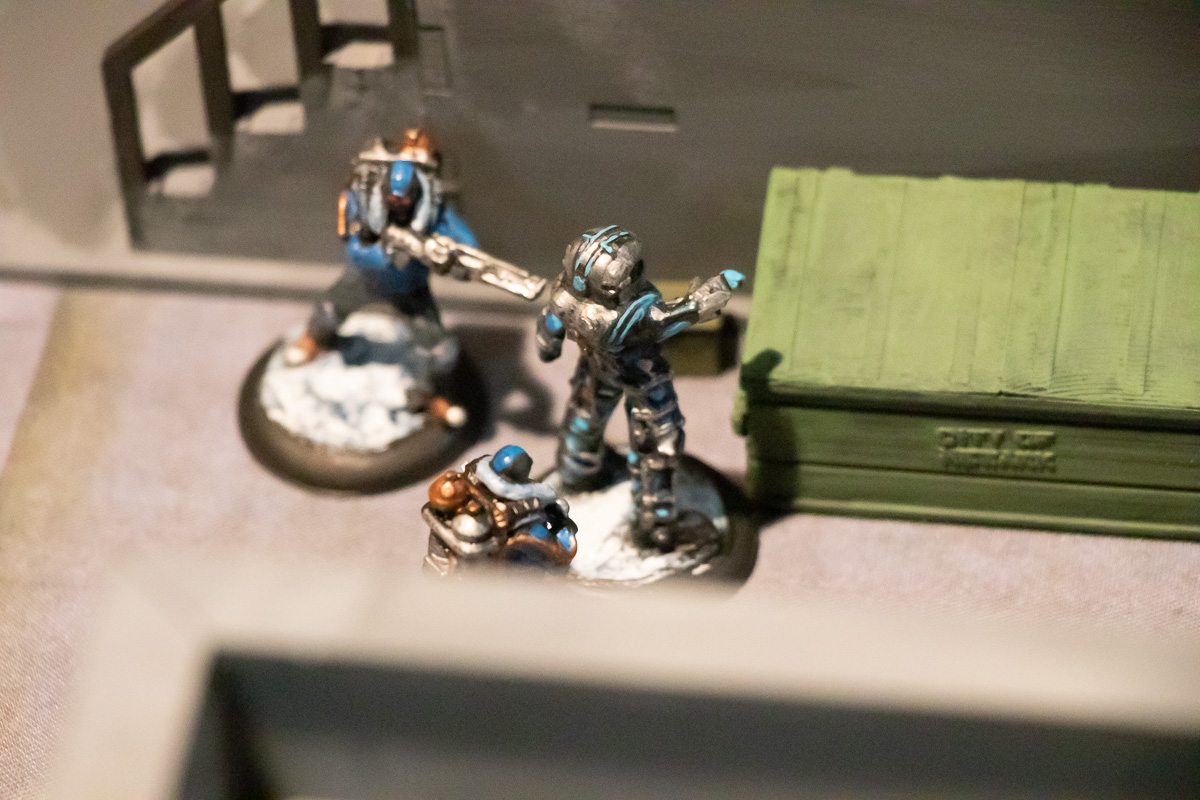
Photos from my recent Batman Miniatures Game scenario. Apologies for the slightly grainy photos. They were taken in a dark basement without a flash.
Some two years after I finished painting the figures, I got in a play of the Batman Miniatures Game on Saturday night. It was a seven player game, with the following teams/factions: Batman and Robin; Batwoman and Red Mask; Freeze; Joker; Penguin; Riddler and; Two-Face. In the scenario, a meteor with Kryptonite exploded over Gotham and all the factions are out to gather the bits.
I thought the game was a lot of fun (2nd edition). The combat mechanisms are pretty ordinary (roll to hit, roll to damage, target may get a dodge), but the planning phase is really good. In the planning phase, players have a certain amount of “Willpower” to allocate among four abilities: Movement, Attack, Defense and Special. On a character’s activation, he expends those points to carry out actions. The planning is sort of a mini game unto itself, where you must anticipate what actions you may need to do when your turn arrives.
The figures were a delight to paint, but a serious pain to assemble. Knight Models makes multipart figures with seemingly little rhyme or reason for the parts division. Joker, for example, inexplicably had a head separate from the body. There was no reason to do that. Other figures had random hands that needed to be attached; none of these made any sense. The figures are also realistically proportioned, which meant that tiny pieces like hands had little surface area to for glue to adhere. I was forced to pin nearly every part on these models, which was extraordinarily (and unnecessarily) laborious.
I can recommend the 2nd edition of the Batman Miniatures Game rules, but potential players should be prepared for a painstaking and exacting miniatures assembly process.
One Hour Skirmish Wargames: Fast Play Diceless Rules For Small Unit Actions From Napoleonics to SciFi by John Lambshead Publisher’s Website: Pen and Sword On Amazon: One Hour Skirmish Wargames
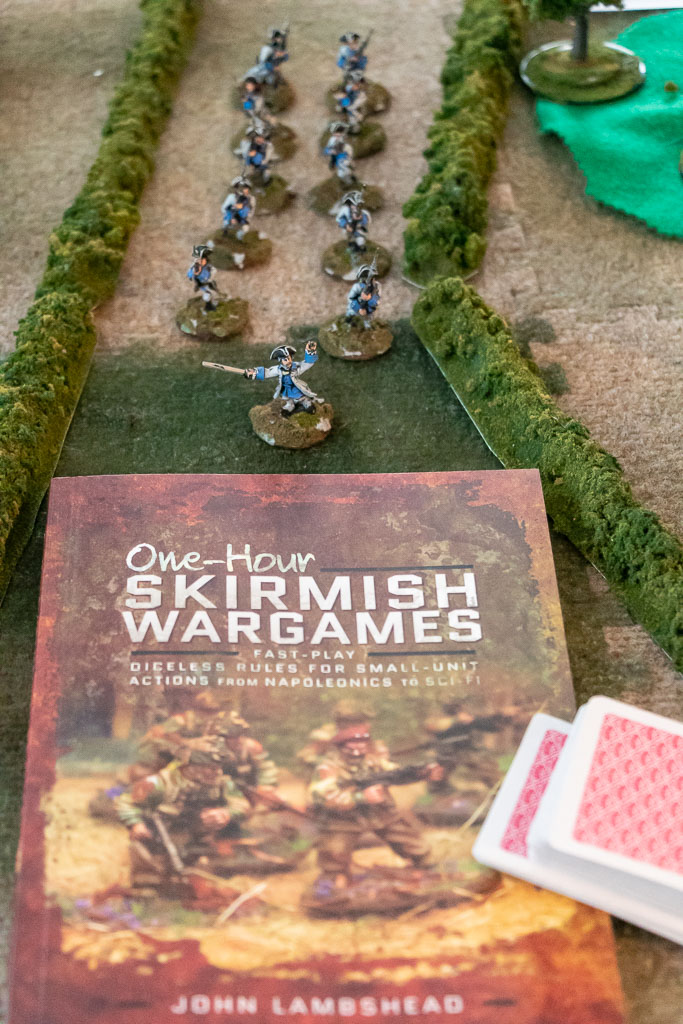
Pen and Sword books recently sent a review copy of a new set of skirmish rules from veteran gamer John Lambshead: One Hour Skirmish Wargames. We used the rules to play a fun scenario set in the French and Indian War.
One Hour Skirmish is en entirely card driven game. Each player has a deck, and cards are flipped to determine turn order, activation points and combat results.
In shooting, for example, players flip and compare the results of their cards. If the attacker’s weapon has a high rate of fire, he flips two or more cards. A defender in cover will flip two, three or four cards, depending upon the defensive situation. In any case, the high card wins.
The result of all this card flipping is a fast-paced, and dramatic game. In a four player game, with around eight to twelve figures per player, we managed to finish in about an hour and a half. Everyone was satisfied with the results, and there were several moments in the game that left us talking afterwards, such as the stand of a British officer and a lone soldier against a large group of coeur de bois and natives.
One of the reasons that the game plays so quickly is that there are no stat lines to track. Grunts are just grunts, and they are either down or out. It is possible to imbue figures with special capabilities, such as “Bruiser” or “Dead Shot,” but it is not the same as having Guy A hit on a 4+ and Guy B hit on a 5+ in more fiddly systems. The special abilities mostly just let you draw extra cards in specific situations.
At some level, having the vast majority of troops with identical abilities make sense in a historical skirmish. On an individual level, it is unlikely that soldiers in the same time period in the age of gunpowder would have wildly different skill levels.
The two areas where opposing forces could have different qualities in a given scenario are their motivation and leadership. The motivation score in this affects the side’s morale breakpoint. Leadership will affect the number of cards drawn when checking said morale.
The One Hour Skirmish base rules are just ten pages long, and actually feel much shorter than that. The remainder of the hundred page paperback is dedicated to period specific scenarios and rules and a points system.
The four of us who played all agreed that we would use these rules again and thought we might try a Boxer Rebellion game. We also agreed, however, that there are some in our larger gaming group who would likely not enjoy the rules. Those gamers tend to like more complicated systems, where differences in training, equipment and doctrine would be more closely modeled.
I can recommend the One Hour Skirmish rules for players who want a quick game with more emphasis on action and drama over “realism” and “crunchiness.”
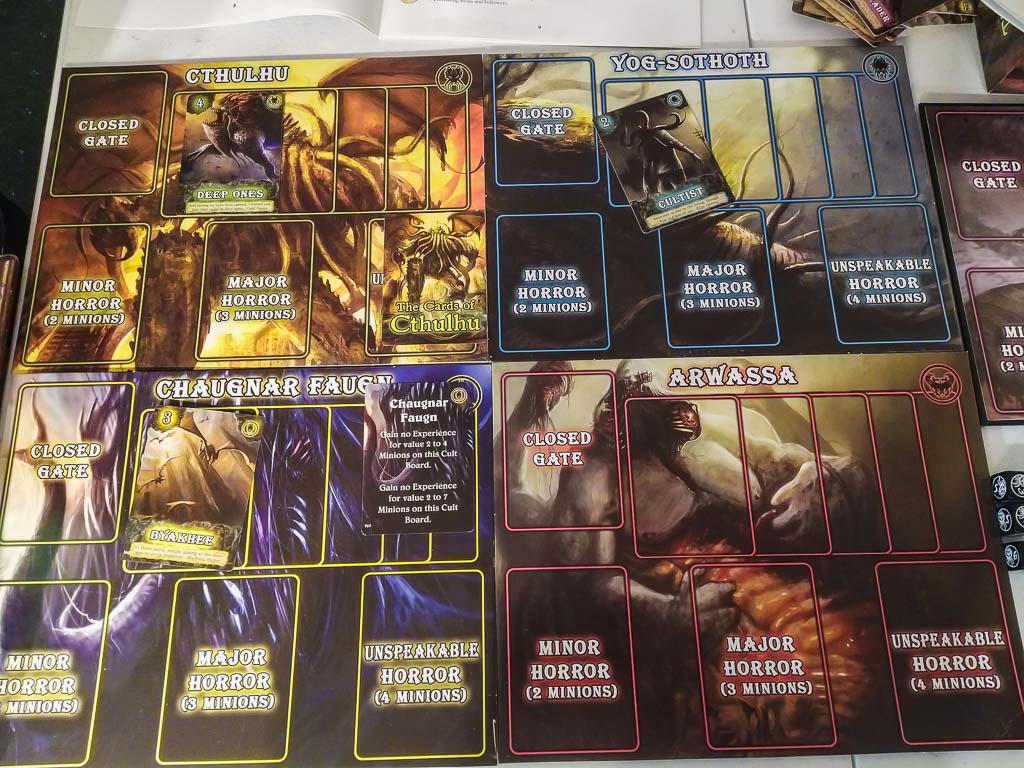
In The Cards of Cthulhu, players take on the role of intrepid investigators trying to keep the minions of four (five with the expansion) cults from opening gates for their Elder Gods. It is a threat management game, as each draw from the deck brings new threats to deal with, or help in the form of items and followers. It is intended as a solo game, but there are rules for higher player counts. I have found it to be an enjoyable experience: quick to set up; easy to play; with a decent amount of tension and decision making. Cards of Cthulhu has enough flavor to keep this Lovecraft fan interested.
Cards of Cthulhu is — as the name suggests — an an almost entirely card driven game. The two hundred card deck (with the expansion) consists of: Minions; Minor, Major and Unspeakable Horrors; Gates; Followers; and Items. On each turn the player draws cards from the deck and then resolves them. Minions, Horrors and Gates are played on the appropriate Cults’ Board. Items and followers can be purchased. Dice are used to resolve combat against Minions and Horrors.
If any Cult’s board ever has five minions present, they summon their Elder God and the game ends in failure. Minions may also trigger the awakening of Minor, Major and Unspeakable Horrors. Gates force the drawing of additional cards, which may potentially add to the turn’s difficulty. The key to the game is to manage each Cult’s minions.
The major resource in the game is “Experience,” which is tracked with thematic coins. Experience is gained by closing gates and killing Minions and Horrors. Experience is spent on items, followers, extra actions, extra dice and other things that can help deal with threats and mitigate the luck of the draw and of the dice.
There are three kinds of dice in Cards of Cthulhu: Body (red), Health (green) and Spirit (white). Each is numbered 1 – 6. When attacking minions, such as a Mi-Go or Cultist, you roll one body and two health dice to try to meet or exceed the cards’ value. Roll higher than the value, and the minion is defeated. Dice can be used individually, or in combination. Combining dice values is the only way to defeat a Minion with a value of 7 – 10.
Horrors are defeated by rolling dice combinations. A Minor Horror is defeated with a two-dice combo — for example, a pair or threes, or a run of 2-3. A three dice Major Horror requires three of a kind or a run of three dice. Unspeakable Horrors require four of a kind or a run of four dice.
Spirit Dice can be purchased with Experience. These add to the dice pool and are obviously the only way to defeat an Unspeakable Horror. Players may also want to add to their dice pool when facing a pile of high value minions.
Cards of Cthulhu is not an overly difficult game, but I have found that it creates an enjoyable feeling of tension and suspense. It also has enough flavor to satisfy my Lovecraft itch. Minions pile up on Cult boards, forcing desperate attempts to reduce their number. Opened gates accelerate the dangers. Horrors compound the difficulty by “shielding” their minions (there is a combat priority — horrors, then minions). Followers must be sacrificed. The day can be saved with the right magic item, or a stick of dynamite. Bad luck (and what Lovecraft story doesn’t have its share of bad luck) in the form of bad die rolls and unlucky card draws work against you.
The artwork is well-done and evokes for me the proper Lovecraftian feel. Overall component production is good, but not great. Card quality is adequate. They are slick and glossy and sturdy enough for many, many plays. I have trouble hand shuffling them, though. Because it is important to the game for them to be really well shuffled (so you don’t get a long run of one Cult’s cards that you can’t deal with), I have resorted to several rounds of pile shuffling before a game. Mash shuffling might also be an option.
I am also convinced that the cards from the expansion are of a slightly different thickness than the base set. That doesn’t matter in terms of game play, though. The next card on the deck is the next card on the deck. The Cult boards are sturdy cardboard, but I find I have to counter-bend them to make them lie flat. I also think that there really aren’t enough Experience tokens.
In truth, though, I’m not even sure why there are tokens. You could just as easily keep the cards of the cultists and horrors you kill near you, and return them to the discard pile as you spend experience. Gates, Minions and discarded followers and items are worth one each. Horrors have an experience value equal to their dice combo value, which is printed on the card. You might have to make “change” with a four dice Unspeakable Horror, but that also would be easy enough.
One nice feature of the Beyond The Veil expansion is that it lets you adjust the duration of the game. A short game involves using a quarter of the cards and drawing 7 cards per turn. A mid-sized game uses half the deck and draws five cards. A full game uses all of the cards and draws four cards per turn. I would recommend picking up the expansion.