

Month: February 2020
The History Behind The Game of Thrones: The North Remembers Book Review
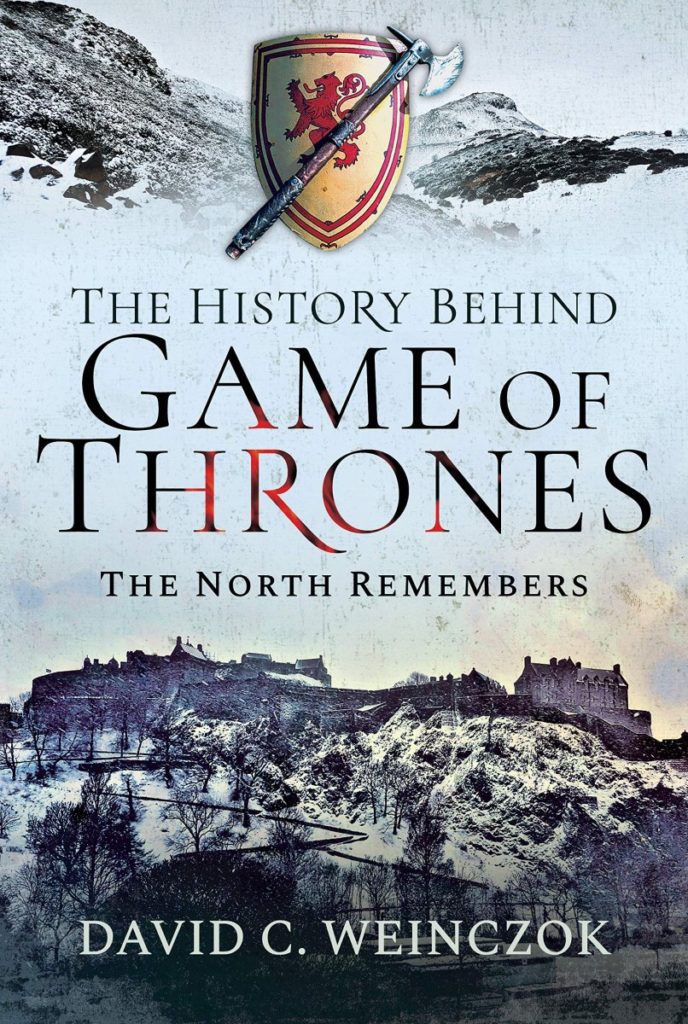
History Behind The Game of Thrones: The North Remembers
by David C Weinczok
Pen and Sword Publishers
Publisher’s Website
Buy On Amazon (affiliate link)
When I first read A Game of Thrones from George RR Martin’s A Song of Ice and Fire series more than 20 years ago, my initial reaction was “Oh. This is a fantasy version of the Wars of the Roses.” Even with only my basic wargamer’s knowledge of the WotR, I was able to see the parallels (anyone interested in a game of Kingmaker?)
It turns out that I wasn’t the only one who had this thought. In The History Behind The Game of Thrones: The North Remembers, David C. Weizczok lays out parallels not only in the Wars of The Roses, but other political and military struggles in Scotland and England, as well as some striking geographical similarities.
The historical Stirling Castle, for example, controls the vital crossing of the River Forth, a strategic situation that closely parallels Westeros’ Moat Cailin and The Twins. The iconic Wall, which separates Westeros from the Wildings of the North, was inspired by Hadrian’s and The Antonine Walls, which separated Roman Britain from the Caledonians. The Iron Islands parallel many locations off the coasts of Britain, notably the Hebrides. Historical Caerlaverock is a nice stand in for Riverrun.
Actual events spanning from Roman times to the Wars of the Roses also are echoed in the Game of Thrones. The futile Wilding assault on the wall, led by their chariots, echoed the equally futile assault of the Caledonians on the Roman Legions anchored on the slopes of Mons Graupius in 83 CE. The Battle of the Bastards looks an awful lot like a merging of Bannockburn and Falkirk. Robert the Bruce’s efforts are reflected in those of Robert Baratheon. Tywin Lannister exhibits many of the characteristics of Edward I.
And then there’s the infamous – and gut wrenching – Red Wedding, which has not one, but THREE parallels in Scottish history: The Black Dinner, James II’s murder of William Douglas and the Massacre of Glencoe. All of these were shocking to contemporaries because of the clear violation of guest-right.
Dragons even have their analog in the castle shattering and fire breathing cannon of the late medieval period.
Weizczok’s book is densely packed with information. Fortunately, it is clearly written and not in the least bit dry for this fan of Game of Thrones and history.
If I have one criticism of the book, it is that the book needs more photos and maps for those of us unfamiliar with English geography. As an American, I can immediately envision maps for the American Revolution and American Civil War. It’s a lot harder for me to envision the geography of the Hebrides , Dumfries and Galloway. There are some maps and photos in the center of the book, but I could have used more. I had to keep my phone handy to keep looking up the locations of places mentioned.
Other than that, I highly recommend this book for anyone who has enjoyed Game of Thrones – either as a book, or in the television format.
Free Company 100 Years War Rules
Andy Clipsom offers a set of rules called Free Company, which is for games set in the longbow era. From the author’s introduction:
I started work on these rules to fulfil some personal gaming criteria. I wanted rules for a small battle but not a skirmish. The command level would therefore be around the unit, rather than the division. I imagine medieval unit commanders using their initiative and experience within an overall game plan, so the player is being a succession of unit commanders with limited initiative, plus the big cheese, who has slightly more control over those around him.
My figures are 25-28mm, but I have only a small space to game, so distances reflect this. I also like multiple bases for ease of movement, so I have returned to simple casualty rosters (though you could use markers). The system should work easily enough for multiple bases in other scales, as it is based on a nominal strength of the base rather than an actual headcount of figures.
The game assumes a game scenario agreed in advance, rather than an equal points, random set up game. It is assumed things not covered in the rules (like scouting, ambushes, destruction aof property) will be covered in the scenario.
Players won�t find a lot of innovative new mechanisms and while some influences are obvious (e.g. the use of DBA PIP-style mechanism to limit the number of actions a player can take), others are lost in the mists of time.
Gaming The Battle of Helms Deep
Doug Larsen has a nice article and scenario for fighting the battle of Helm’s Deep. He has obviously spent a lot of time studying the source material for both the maps and the forces.
Netherhells Heroic Fantasy Rules
Heresy Miniatures offers a heroic fantasy game called “Netherhells.” It’s a dungeon-crawl game, with players facing a game master.