I have in recent weeks played two games of Tea Garden and am itching to play it again.
Designed by Tomáš Holek and published by Capstone Games, Tea Garden combines deck building and hand managment with a hint of area control and track advancement.
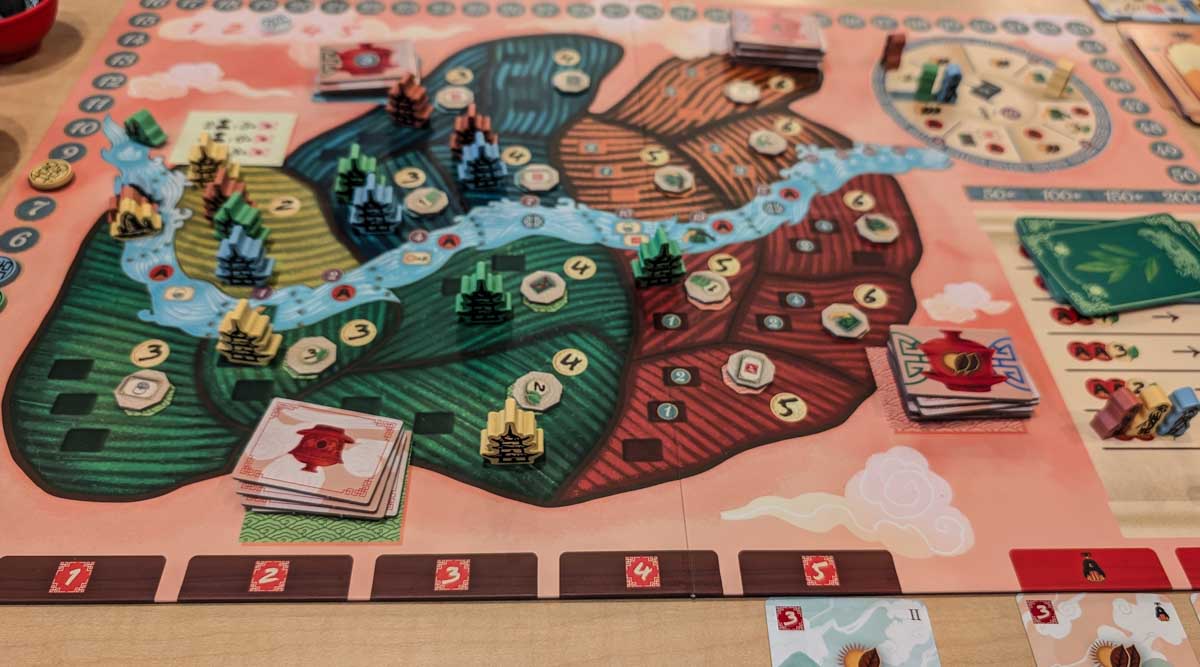
Players have cards in their hands of varying strengths and abilities, which they play to do things like buy new cards, expand tea houses on the board, progress down a resource laden river, harvest or ferment tea leaves, sell tea to caravans, study at the university and advance up the emperor track. A turn consists simply of playing one or more cards and taking a primary action whose “strength” is the sum of the values on the card. Depending on the cards’ iconography, a player may also take a secondary action.
And that’s it. Play a couple of cards, do the thing (and perhaps a second thing), and it is the next person’s turn.
This is not to say Tea Garden is simple. There is a lot to think about, particularly regarding the sequence of actions. It is just that you will not be able to daisy chain a bunch of actions into a twenty minute long sequence of: I do this, which lets me do this, which lets me do that, which lets me do another thing et. al
Instead, players need to take one turn to set up their next, while paying attention to a board state that may change in the interim.
Tea Garden plays quickly, with just five rounds in which players will take three or maybe four main actions and perhaps a similar number of secondary actions. The “do a thing; next person’s turn” nature of the game makes it move quickly. Tea Garden does not overstay its welcome. Indeed, my feeling is always “I want one more turn.”
The game has nine pages of well-illustrated rules, three of which are setup. Tea Garden is not a game with a lot of rules overhead. The complexity is emergent, which to my mind is a sign of an excellent design.
Recommended.